

Gift and Estate Taxes
Jun 21, 2023
 If you give away money or property during your life, those transfers may be subject to federal gift and estate tax and perhaps state gift tax. The money and property you own when you die (i.e., your estate) may also be subject to federal gift and estate tax and some form of state death tax. These property transfers may also be subject to generation-skipping transfer taxes. You should understand all of these taxes, especially since the passage of the Economic Growth and Tax Relief Reconciliation Act of 2001 (the 2001 Tax Act), the Tax Relief, Unemployment Insurance Reauthorization, and Job Creation Act of 2010 (the 2010 Tax Act), the American Taxpayer Relief Act of 2012 (the 2012 Tax Act), and the Tax Cuts and Jobs Act. The recent Tax Acts contain several changes that make estate planning much easier.
Tags: Certified Financial Advisor Charlotte NC, Certified Financial Planner Charlotte NC, Estate Planning, Family Wealth, Investing, Philanthropic Planning
Bypassing Probate
Jun 16, 2023

You may have heard about the horrors of probate, but in truth, probate has gotten an undeservedly bad reputation, especially in recent years. If you bypass probate, your estate will go to your beneficiaries without any court proceeding, and you may save a certain amount of time and expenses. However, there is usually little reason for most people to avoid probate today. States continue to revise their probate laws, making them more consumer friendly, particularly for small estates. For most modestly sized estates, the probate process now costs little. In fact, there are some good reasons to distribute your property by will. Decisions are binding and have legal finality once your will is probated. Creditors who fail to file claims against your estate within a specific amount of time — usually six months after receiving notice — are out of luck.
Tags: Estate Planning, financial advisor charlotte nc, Personal Finance, Retirement Planning
Understanding Social Security
May 12, 2023
 Approximately 70 million people today receive some form of Social Security benefits, including retirement, disability, survivor, and family benefits.1 Although most people receiving Social Security are retired, you and your family members may be eligible for benefits at any age, depending on your circumstances.
Tags: Certified Financial Planner Charlotte NC, Estate Planning, Family Wealth, financial advisor charlotte nc
Estimating Your Retirement Income Needs
May 8, 2023
 You know how important it is to plan for your retirement, but where do you begin? One of your first steps should be to estimate how much income you’ll need to fund your retirement. That’s not as easy as it sounds, because retirement planning is not an exact science. Your specific needs depend on your goals and many other factors.
Tags: Certified Financial Planner Charlotte NC, Estate Planning, Family Wealth, financial advisor charlotte nc, retirement, Retirement Planning, Retirement Tax Savings
An Introduction to Estate Planning
Apr 26, 2023

By definition, estate planning is a process designed to help you manage and preserve your assets while you are alive, and to conserve and control their distribution after your death according to your goals and objectives. But what estate planning means to you specifically depends on who you are.
Tags: Estate Planning, Family Wealth, financial advisor, financial advisor charlotte nc, Long-Term Care Planning, Personal Finance, retirement, Retirement Planning
Digital Assets Estate Strategy
Mar 20, 2023

When you think about your estate, you may think about your personal property, real estate, or investments. You also have other, less-tangible assets – and they deserve your attention as well. We consider these your digital assets. A digital footprint of your life – and you need to consider them within your estate planning. (more…)
Tags: Certified Financial Planner Charlotte NC, Estate Planning, Family Wealth, financial advisor charlotte nc, Financial Planning
Will You Avoid These Estate Planning Mistakes?
May 27, 2022

Many people plan their estates diligently, with input from legal, tax, and financial professionals. Others plan earnestly but make mistakes that can potentially affect both the transfer and destiny of family wealth. Here are some common and not-so-common errors to avoid during estate planning. (more…)
Tags: Certified Financial Planner Charlotte NC, Estate Planning, financial advisor, Investments, Personal Finance, retirement, Retirement Planning, Retirement Tax Savings, social security
Estate Planning for Baseball’s $300 Million Players
Apr 13, 2022

The San Diego Padres signed infielder Fernando Tatis, Jr., to a 14-year, $340 million contract roughly one year after the Los Angeles Dodgers inked outfielder Mookie Betts to a 12-year, $365 million deal. That brings the total to 8 baseball players who have signed long-term, $300+ million contracts. Think he needs estate planning? (more…)
Tags: Certified Financial Planner Charlotte NC, Estate Planning, Family Wealth, financial advisor charlotte nc, Financial Planning, Legacy
A Corporate Trustee Could Be a Smart Choice
Feb 7, 2022

In an ideal world, managing a family trust would be simple. There would be no stress, no big learning curve, and no great time commitment involved. Unfortunately, the world is not ideal, and heirs who become trustees are often left with headaches. A corporate trustee may be a good option. (more…)
Tags: Certified Financial Planner Charlotte NC, Estate Planning, Family Wealth, financial advisor charlotte nc, Investment Planning, Personal Finance, taxes
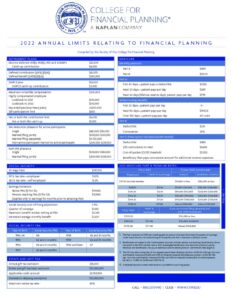
2022 Annual Limits for Financial Planning
Jan 7, 2022
Tags: Certified Financial Planner Charlotte NC, Estate Planning, financial advisor charlotte nc, Financial Planner Charlotte NC, Financial Planning, Retirement Planning, Tax Planning, tax season guide
More Insights
Jul 9, 2025
Few terms in personal finance are as important, or used as frequently, as “risk.” Nevertheless, few terms are as imprecisely defined. Generally, when financial advisors or the media talk about investment risk, their focus is on the historical price volatility of the asset or investment under discussion.
Jul 7, 2025
As Americans get their grills and beach chairs ready for the July 4th holiday, the stock market and the weather across much of the country have both been on heaters. Stocks and bonds continue to effectively navigate a complex policy landscape shaped by evolving trade dynamics, geopolitical tensions, and fiscal stimulus. The market’s resilience in … Continue reading “Market Update – America Gets Record High Stock Prices for Its Birthday”
Jun 20, 2025
Birthdays may seem less important as you grow older. They may not offer the impact of watershed moments such as getting a driver’s license at 16 and voting at 18. But beginning at age 50, there are several key birthdays that can affect your tax situation, health-care eligibility, and retirement benefits.
Jun 18, 2025
During times like these when geopolitical headlines can be unsettling for investors, we at LPL Research like to remind ourselves of one of our key investing principles. Markets have always faced challenges —ranging from geopolitical conflicts and economic downturns to natural disasters, political upheaval and health crises. These events often trigger short-term volatility and shake … Continue reading “Why Long Term Investing Beats Selling in Volatile Times”
Jun 16, 2025
Are you concerned about the inheritance taxes your heirs may have to pay? Then you may want to consider creating charitable lead trusts.
 Top of Page







Services
Epic Capital provides the following comprehensive financial planning and investment management services: Learn More >


Find us on:


Copyright © 2026 Epic Capital Wealth Management. All Rights Reserved.
Securities offered through LPL Financial. Member FINRA/SIPC.
The LPL Financial representative associated with this website may discuss and/or transact securities business only with residents of the following states: CA, CO, DC, DE, FL, GA, IN, LA, MD, MO, MS, NC, NJ, NY, PA, SC, TN, TX, VA, VT, WA.